

How the International Sustainability Standards Board’s (ISSB) standards of IFRS S1 and S2 are reshaping sustainability disclosure, climate risk governance, and investor expectations – and what it means for organisations across the Gulf Cooperation Council (GCC) region.
Sustainability reporting is undergoing a fundamental transformation across the Gulf. What was once largely viewed as a voluntary ESG communication exercise is increasingly part of mainstream financial disclosure and enterprise risk management. Investors, regulators, lenders, and other stakeholders are demanding more decision-useful, financially material sustainability information that can be compared consistently across markets and sectors.
The IFRS S1 and IFRS S2 standards, issued by the International Sustainability Standards Board (ISSB), establish a globally consistent baseline for sustainability-related financial disclosures, enabling organisations to communicate how sustainability and climate-related risks affect enterprise value, financial performance, and long-term resilience.
Across the GCC, regulatory momentum around sustainability-related financial disclosure is accelerating. The UAE has progressively strengthened sustainability disclosure and climate-risk governance requirements, while Qatar has commenced mandatory implementation of ISSB-aligned sustainability disclosure requirements for financial years beginning on or after 1 January 2026, and Oman has formally adopted IFRS S1 and IFRS S2, with mandatory application from 1 January 2029. Bahrain has also introduced mandatory ESG reporting requirements for listed companies and specified financial institutions. For GCC organisations pursuing diversification, net zero ambitions, and deeper participation in global capital markets, demonstrating integrated sustainability governance is becoming a critical market expectation.
IFRS S1 and IFRS S2 are the first sustainability disclosure standards issued by the ISSB. Together they establish a framework for organisations to disclose sustainability-related financial information in a consistent, comparable, and investor-focused manner.
The standards work together: IFRS S1 establishes the overall disclosure framework, while IFRS S2 provides the first topic-specific standard focused on climate. Transitional relief in the first year allows organisations to focus primarily on climate-related disclosures, supporting a phased approach.
Requires disclosure of sustainability-related risks and opportunities that could reasonably affect enterprise value over the short, medium, or long term. IFRS S1 places sustainability firmly within the context of governance, enterprise risk management, and financial reporting.
Builds on the TCFD recommendations and requires disclosure of climate governance structures, transition planning, climate resilience, greenhouse gas emissions, and the financial implications of climate-related risks. IFRS S2 positions climate risk as a strategic and financial issue, not merely an environmental one.
Both standards are structured around four core pillars originally established through the TCFD framework. These pillars are designed to embed sustainability-related risks into core business decision-making processes, making climate and ESG governance a board-level responsibility across GCC organisations.
Climate-related financial risk management is rapidly becoming a regulatory expectation across GCC markets. Central banks, financial regulators, and capital market authorities are progressively introducing climate risk, ESG disclosure, and sustainable finance requirements aligned with international frameworks such as IFRS S1 and S2, TCFD, and global prudential risk management practices.
| Country | Authority | Regulation / Mandate / Guidance | Applicable To | Date of Application |
|---|---|---|---|---|
| UAE | Central Bank of the United Arab Emirates (CBUAE) | Climate-related Financial Risk Management Regulation | Banks, insurers, financial institutions licensed and regulated by the CBUAE | Supervisory expectations and phased implementation beginning 2025 |
| UAE | Dubai Financial Services Authority (DFSA) | Principles for the Effective Management of Climate-Related Financial Risks | DFSA-regulated financial institutions operating in the Dubai International Financial Centre (DIFC) | Effective from 2023 through DFSA ESG and climate-related risk management expectations |
| Qatar | Qatar Financial Markets Authority (QFMA) | IFRS S1 & S2 sustainability disclosure requirements under the Governance Code for Listed Companies | Companies listed on the Main Market | Financial years beginning on or after 1 January 2026 |
| Qatar | Qatar Central Bank (QCB) | Sustainability Reporting Framework (IFRS S1 & S2) | QCB-regulated banks and insurance companies | Annual financial reporting periods beginning on or after 1 January 2026 |
| Qatar | Qatar Financial Centre Regulatory Authority (QFCRA) | Corporate Sustainability Reporting Rules aligned with IFRS S1 & S2 | All Category A firms and other authorised firms designated by the QFCRA | From 1 January 2026 |
| Oman | Financial Services Authority (FSA) | Requirements for Disclosure of Environmental, Social and Governance (ESG) Practices | All publicly listed joint stock companies listed on the Muscat Stock Exchange | Phased implementation, full mandatory application 2029 |
| Oman | Central Bank of Oman (CBO) | Promoting Sustainable and Green Financial Practices | All banks and licensed financial institutions regulated and supervised by the Central Bank of Oman | Issued October 2024; phased implementation with disclosures from FY2026 |
| Bahrain | Central Bank of Bahrain (CBB) | Environmental, Social and Governance (ESG) Requirements Module | CBB-regulated financial institutions and licensees | Issued in 2023 with phased implementation from 2024 |
Preparing for IFRS S1 and S2 across the GCC requires moving beyond traditional sustainability reporting toward more integrated, governance-driven, and financially connected disclosure. The following seven steps are critical for organisations at any stage of readiness.
Many GCC organisations already produce sustainability reports aligned with GRI, CDP, or TCFD. However, these systems often require noteworthy development to meet the more meticulous requirements of IFRS S1 and S2. The most common readiness challenges across the MENA region include:
The shift is less about creating new disclosures, and more about strengthening reporting controls, methodology discipline, and integration between sustainability, finance, risk, and operations.
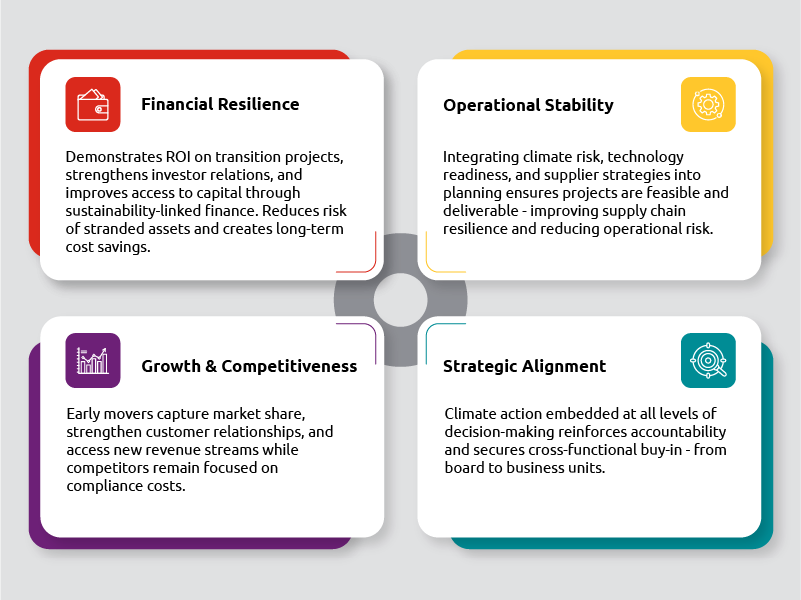
Climate risk is no longer merely an environmental or reputational issue for GCC organisations – it is a financial and strategic one. As physical climate risks such as extreme heat, water scarcity, and supply chain disruption become more material, organisations that proactively address climate-related financial disclosure will be better positioned across four dimensions:
AESG supports organisations across the GCC and globally in navigating the transition from traditional ESG reporting toward more integrated sustainability-related financial disclosure aligned with IFRS S1 and S2. AESG combines technical sustainability expertise with engineering, infrastructure, and strategic advisory capabilities, helping organisations translate sustainability and climate-related risks into practical business decisions, stronger governance, enhanced resilience, and long-term value creation.
Supporting organisations in aligning sustainability and climate disclosures with evolving regulatory requirements and global frameworks.
Helping organisations identify, assess, and manage physical and transition climate risks across operations, infrastructure, assets, and value chains.
Supporting organisations in developing practical transition pathways aligned with net zero ambitions, operational priorities, and long-term business strategy.
Strengthening internal governance structures, leadership capability, and cross-functional implementation readiness.
Organisations that proactively strengthen disclosure maturity, governance, and climate risk management capabilities will be better positioned to improve investor confidence, access capital, and navigate an increasingly sustainability-driven business environment.


Associate Director of Strategy and Advisory, UAE
AESG
Wojciech is a strategic and results-driven sustainability leader with over 12 years of experience delivering complex advisory projects. As Associate Director – Strategy & Advisory at AESG, he leads multidisciplinary teams in delivering sustainability, net zero, and decarbonisation strategies across sectors for clients in the Middle East, overseeing projects from inception to completion while driving client engagement, business growth, and technical excellence.
He is highly skilled in ESG strategy development and implementation, reporting, and governance, with a strong record of delivering impactful outcomes for clients across the real estate, infrastructure, and aviation sectors. Wojciech specialises in shaping ESG frameworks, guiding organisations through regulatory and market transitions, and embedding responsible business practices into core corporate strategies.
Recognised as a thought leader in his field, Wojciech has contributed to FIDIC’s Future Leaders Booklets (2023–2025), received the Outstanding Achievement Award at the FIDIC Future Leaders Awards (2023), and was named among the 35 Under 35 in Sustainability (2024). He regularly speaks at international forums, including the Global Infrastructure Conference (Singapore, Geneva, and Cape Town), where his insights help shape best practice in ESG and sustainability advisory.
Holding an Executive MBA from Aalto University Business School and a certificate in Leading Strategic and Transformational Change from Yale School of Management, Wojciech combines academic insight with practical advisory expertise. He is passionate about driving sustainability transformations that are ambitious, credible, and commercially viable.

Principal Consultant – Strategy & Advisory
AESG
Sarthak is an ESG and Sustainability professional with 9+ years of experience driving high-impact ESG strategy development, execution, and performance tracking across public and private sectors. He is adept at applying structured, inclusive, and outcome-oriented problem-solving approaches to address complex business and policy challenges.
He has demonstrated success in managing multi-stakeholder engagements and leading cross-functional teams to deliver results in areas including: ESG strategy development aligned with global frameworks; Scope 1, 2, and 3 GHG inventory and emissions accounting; double materiality and impact-financial materiality assessments; regulatory compliance advisory; Net Zero planning and decarbonisation pathway modelling; climate risk assessments and scenario analysis; ESG data analytics and dashboard development; stakeholder engagement and ESG governance structuring; ESG and climate disclosures with audit-ready reporting; and life cycle assessment (LCA) and Scope 3 emissions evaluation.
For further information relating to specialist consultancy engineering services, feel free to contact us directly via info@aesg.com

ISO 27001:2022
ISO 9001:2015
ISO 14001:2015
ISO 45001:2018
601-608, The offices at Ibn Battuta Gate
Jebel Ali 1-Village
PO Box 2556
Dubai, United Arab Emirates
T / +971 (0) 4 432 6242
305 Mermaid House
2 Puddle Dock
London, EC4V 3DS
United Kingdom
T / +44 (0) 208 037 8762
Haibu Space, Abu Dhabi Mall
1st floor, Office 37
Tourist Club Area
Abu Dhabi, United Arab Emirates
T / +971 (0) 2 201 2527
9391 Wadi Al Thummamah
2444 Al Olaya District
PO Box 12214
Riyadh, Kingdom of Saudi Arabia
T / +966 (0) 112 278 288
111 Somerset Road
#08-10A, 111 Somerset
Singapore 238164
11th Floor, Office 1101
2 Long Street
Cape Town 8000
Western Cape, South Africa
T / +27 (0) 21 137 6444
8 Parramatta Square
49th Floor, Office 117
Parramatta, Sydney
New South Wales 2150
Australia
T / +61 (0) 2 8042 6817
32/F, 367 Collins Street
Melbourne, VIC 3000
Australia
T / +61 (0) 3 8612 7200
Floor 3
Office No. 8, Signature Square Building
Moustafa Kamel Axis
New Cairo 1
Egypt
T / +20 (0) 2 2344 1268
601-608, The offices at Ibn Battuta Gate
Jebel Ali 1-Village
PO Box 2556
Dubai, United Arab Emirates
T / +971 (0) 4 432 6242
305 Mermaid House
2 Puddle Dock
London, EC4V 3DS
United Kingdom
T / +44 (0) 208 037 8762
Haibu Space, Abu Dhabi Mall
1st floor, Office 37
Tourist Club Area
Abu Dhabi, United Arab Emirates
T / +971 (0) 2 201 2527
9391 Wadi Al Thummamah
2444 Al Olaya District
PO Box 12214
Riyadh, Kingdom of Saudi Arabia
T / +966 (0) 112 278 288
111 Somerset Road
#08-10A, 111 Somerset
Singapore 238164
11th Floor, Office 1101
2 Long Street
Cape Town 8000
Western Cape, South Africa
T / +27 (0) 21 137 6444
8 Parramatta Square
49th Floor, Office 117
Parramatta, Sydney
New South Wales 2150
Australia
T / +61 (0) 2 8042 6817
32/F, 367 Collins Street
Melbourne, VIC 3000
Australia
T / +61 (0) 3 8612 7200
Floor 3
Office No. 8, Signature Square Building
Moustafa Kamel Axis
New Cairo 1
Egypt
T / +20 (0) 2 2344 1268
Copyright 2026 | AESG | All Rights Reserved