

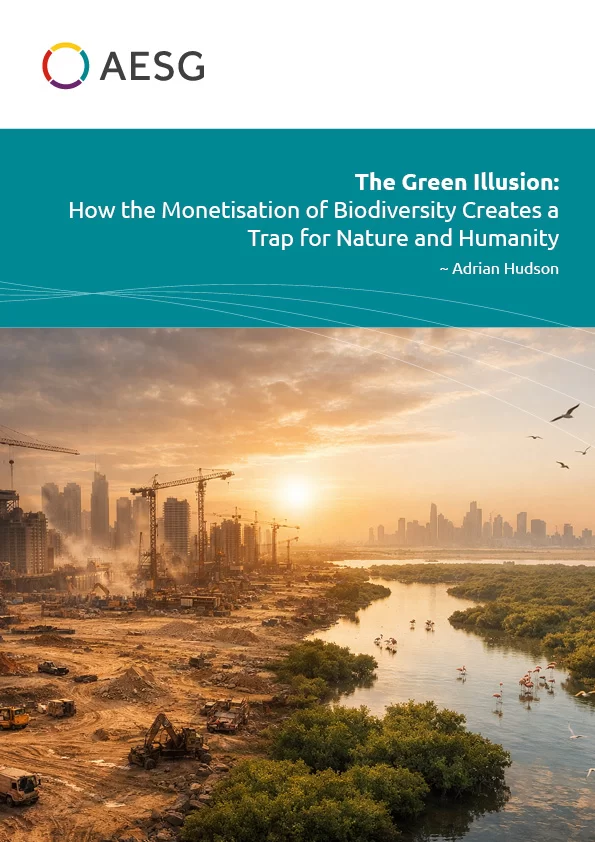
As we approach the halfway mark of 2026, the global response to the accelerating sixth mass extinction event has increasingly pivoted toward a singular, technocratic, and economic solution: the monetisation of biodiversity. The core assumption of this paradigm is that biodiversity loss occurs because nature is treated as a free good, a market failure that can be corrected by internalising externalities. Under the banner of nature-positive systems, biodiversity offsets, credits, and banking seek to put a price on ecosystem services, aiming to reconcile conservation with economic growth.
However, this approach is a perilous trap. By converting complex ecological processes into commensurable financial assets—biodiversity units—we are not saving nature; we are merely allowing its degradation to be accounted for in corporate balance sheets. This essay argues that monetising biodiversity is a conceptual, social, and ecological trap that accelerates the commodification of life, encourages the destruction of ecosystems under the guise of net gain, undermines the rights of indigenous communities, and perpetuates the same economic logic that caused the crisis in the first place.
The first and most fundamental trap of monetising biodiversity lies in the assumption that nature can be reduced to a unit of exchange. This is a form of neoliberal conservation, where ecological value is replaced by monetary value, making ecosystems interchangeable assets.
Biodiversity is complex, functional, and deeply contextual. A hectare of ancient forest in the Congo Basin or Amazon is not merely a carbon-storing unit equivalent to a hectare of newly planted mono-culture pine in Indonesia, yet market mechanisms frequently treat them as such. This reframes nature in terms of isolated biodiversity units that can be simply defined, measured and exchanged across time and space. When we commodify biodiversity, we lose the qualitative specificity of place—the unique cultural and ecological relationships that define it.
Monetary valuation, such as that promoted by the World Economic Forum, claims to raise awareness by quantifying nature’s contributions. However, it inevitably leads to better than nothing conservation, where nature is conserved only if it shows a positive cost-benefit ratio. When biodiversity is priced, anything deemed less valuable than development is sacrificed. This method fails to account for intrinsic values, spiritual connections, or the ecological tipping points that, once crossed, make restoration impossible.
The most significant operational trap is the biodiversity offset mechanism. Biodiversity offsets are, in essence, a mechanism where environmental losses are traded for restoration gains. This allows corporations to destroy biodiversity at a development site, provided they pay for equivalent gains elsewhere.
These schemes frequently serve as a licence to degrade or destroy biodiversity in exchange for uncertain, long-term environmental gains. The promise of no net loss or net gain is often an illusion, as the biodiversity offset method struggles with basic ecological realities. The destruction of an established, functioning ecosystem is often immediate, while the purported offset—such as a restored wetland—may take decades to develop, or fail entirely.
Like carbon offsetting, biodiversity offsetting serves to delay the necessary systemic changes required to combat the root causes of biodiversity decline. Instead of avoiding destruction, companies are encouraged to offset it, offering a temporary fix rather than a long-term solution.
The monetisation of biodiversity is not a neutral technocratic fix. It is a political process that redistributes power and resources, often at the expense of local communities and indigenous peoples.
Biodiversity credits are often sourced from the Global South, where land is perceived as sterilised or undervalued by financial actors. This leads to a green grab, where indigenous lands are enclosed and managed for international biodiversity markets, restricting local access to resources that communities have relied on for generations.
The neoliberalisation of conservation favours formal, scientific metrics over traditional, land-based knowledge. When biodiversity is transformed into a unit, the people who know it best—the local stewards—are rendered invisible in favour of international consultants and auditors.
Perhaps the ultimate trap is that the monetisation of biodiversity requires the expansion of the same economic system that caused the crisis.
Monetisation does not challenge the imperative for relentless economic growth; it simply tries to make that growth green. It assumes that if we assign a price to a bird or a forest, the market will magically protect it. This is a fundamental misunderstanding of the market, which operates for profit, not ecological integrity.
As argued by figures such as Joseph Stiglitz, there is a push to price biodiversity risk. However, this leads to the commodification of nature, turning biodiversity into a speculative asset class. The green trap of debt for nature swaps means that developing nations become trapped in financial arrangements that prioritise the repayment of debt via the production of ecological credits, rather than the intrinsic protection of their own ecosystems.
The push to monetise biodiversity is not the solution to the environmental crisis; it is an escalation of the mindset that created it. By treating nature as a commodity, we are reducing its capacity to support life and ignoring its intrinsic worth. The traps of biodiversity offsetting, commodification, and the commodification of nature are not merely flaws in implementation; they are inherent in the logic of putting a price on nature.
Breaking this trap requires:
The true value of nature cannot be calculated in currency. It is time to treat biodiversity not as a capital asset, but as the foundation of life itself.


Senior Associate Director of Environment, UAE
AESG
Adrian Hudson is the Senior Associate Director at AESG, he is an ecologist and biodiversity specialist with a proven track record in the fields of ecology and conservation biology spanning almost 30 years. Adrian holds a Master of Science degree in Ecology from the North West University in South Africa and is registered as a professional natural scientist in South Africa and the United Arab Emirates. He has been working exclusively as an ecological consultant in the fields of general and restoration ecology for almost 20 years. Adrian has extensive experience working on a wide range of environmental and conservation projects in Africa, the Middle East, South America, Eastern Europe, Australia and India with clients from both the private and public sectors. He has extensive experience in inter alia terrestrial and wetland ecological assessments, restoration ecology, biodiversity management and ecosystem services. Adrian has completed more than four hundred projects, in more than forty countries in accordance with international best practice, including to World Bank and IFC standards, consulting on more than 300 projects in more than 40 countries.
Adrian is also a member of several professional/expert associations and panels, including the Birdlife SA panel on Birds and Renewable Energy, and the South African Department of Environmental Affairs Roster of Experts on Ecology and Desertification. He is currently a reviewer for several internationally accredited scientific journals and is also credited with authorship of several articles published in accredited scientific journals. Although working as a consultant in the private sector, Adrian has strong academic ties and is currently co-supervisor of two post- graduate students completing their MSc degrees in ecology and has previously supervised postgraduate students for two universities, namely North West University and Stellenbosch University.
For further information relating to specialist consultancy engineering services, feel free to contact us directly via info@aesg.com

ISO 27001:2022
ISO 9001:2015
ISO 14001:2015
ISO 45001:2018
601-608, The offices at Ibn Battuta Gate
Jebel Ali 1-Village
PO Box 2556
Dubai, United Arab Emirates
T / +971 (0) 4 432 6242
305 Mermaid House
2 Puddle Dock
London, EC4V 3DS
United Kingdom
T / +44 (0) 208 037 8762
Haibu Space, Abu Dhabi Mall
1st floor, Office 37
Tourist Club Area
Abu Dhabi, United Arab Emirates
T / +971 (0) 2 201 2527
9391 Wadi Al Thummamah
2444 Al Olaya District
PO Box 12214
Riyadh, Kingdom of Saudi Arabia
T / +966 (0) 112 278 288
111 Somerset Road
#08-10A, 111 Somerset
Singapore 238164
11th Floor, Office 1101
2 Long Street
Cape Town 8000
Western Cape, South Africa
T / +27 (0) 21 137 6444
8 Parramatta Square
49th Floor, Office 117
Parramatta, Sydney
New South Wales 2150
Australia
T / +61 (0) 2 8042 6817
32/F, 367 Collins Street
Melbourne, VIC 3000
Australia
T / +61 (0) 3 8612 7200
Floor 3
Office No. 8, Signature Square Building
Moustafa Kamel Axis
New Cairo 1
Egypt
T / +20 (0) 2 2344 1268
601-608, The offices at Ibn Battuta Gate
Jebel Ali 1-Village
PO Box 2556
Dubai, United Arab Emirates
T / +971 (0) 4 432 6242
305 Mermaid House
2 Puddle Dock
London, EC4V 3DS
United Kingdom
T / +44 (0) 208 037 8762
Haibu Space, Abu Dhabi Mall
1st floor, Office 37
Tourist Club Area
Abu Dhabi, United Arab Emirates
T / +971 (0) 2 201 2527
9391 Wadi Al Thummamah
2444 Al Olaya District
PO Box 12214
Riyadh, Kingdom of Saudi Arabia
T / +966 (0) 112 278 288
111 Somerset Road
#08-10A, 111 Somerset
Singapore 238164
11th Floor, Office 1101
2 Long Street
Cape Town 8000
Western Cape, South Africa
T / +27 (0) 21 137 6444
8 Parramatta Square
49th Floor, Office 117
Parramatta, Sydney
New South Wales 2150
Australia
T / +61 (0) 2 8042 6817
32/F, 367 Collins Street
Melbourne, VIC 3000
Australia
T / +61 (0) 3 8612 7200
Floor 3
Office No. 8, Signature Square Building
Moustafa Kamel Axis
New Cairo 1
Egypt
T / +20 (0) 2 2344 1268
Copyright 2026 | AESG | All Rights Reserved
